
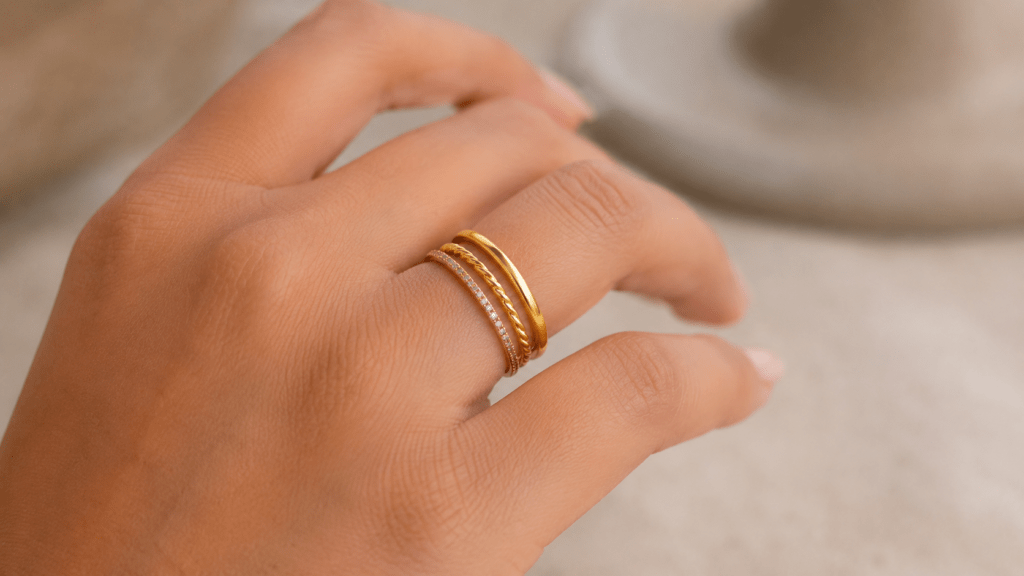
Stackable Rings Win on Modular Design Economics, Not SKU Count
Most jewelry brands burn their Series A chasing SKU volume when stackable rings prove that fewer, smarter components beat a catalog nobody can restock.
The Unit Economics of Modularity
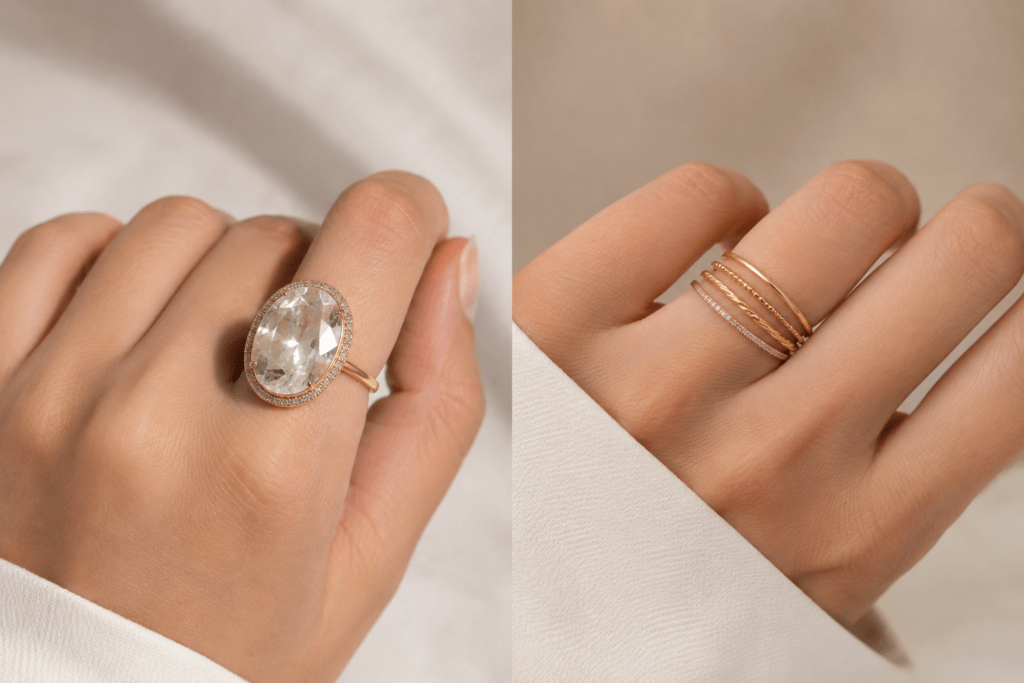
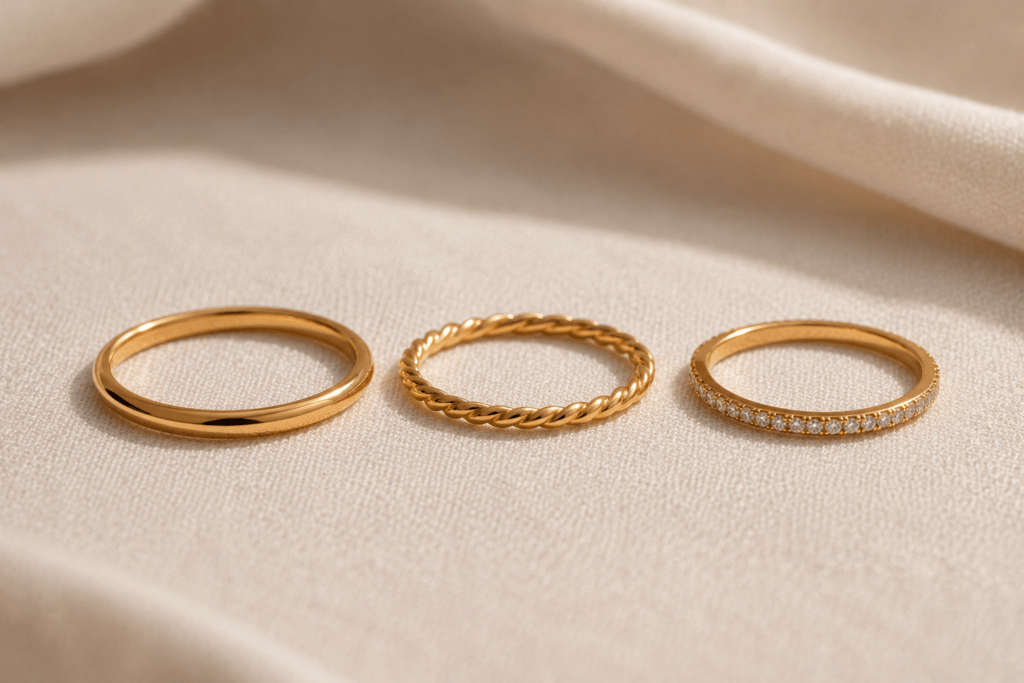
Technical founders understand combinatorics better than most jewelry buyers, and that’s exactly the edge stackable rings offer. A traditional fine jewelry catalog needs a distinct SKU for every ring a customer might want, which means holding inventory across hundreds of low-velocity designs. Stackable rings collapse that problem: a founder can launch fifteen base components, band widths, stone settings, and finishes, and let customers combine them into hundreds of unique looks. The manufacturing cost stays tied to fifteen SKUs. The perceived product range looks like hundreds.
Mejuri built its early growth on exactly this mechanic, launching a tight core collection of stackable rings and bands that customers combined rather than a sprawling one-off catalog. That decision cut working capital tied up in inventory while increasing average order value, because customers who buy one stackable ring almost always come back for a second or third to complete a set. Run the math on inventory turns for a modular ring system versus a traditional one-SKU-per-design catalog, and modularity wins on both cash efficiency and repeat purchase rate, because the product itself creates the reason to reorder.
Speed Comes From Component Reuse, Not Faster Production Lines
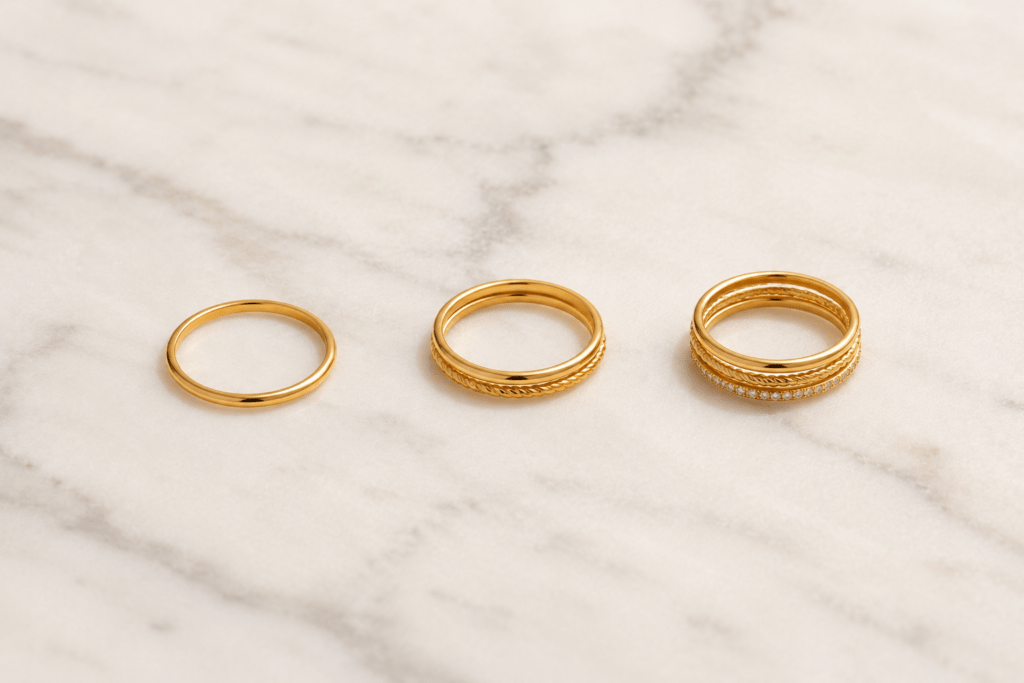
Series A founders default to solving speed with more manufacturing capacity. For stackable rings, the faster lever is component reuse. A single band design, produced in three metals and five sizes, can anchor a dozen finished products when paired with different stone settings or texture variants. That’s the same logic a software team uses when building on shared components instead of writing bespoke code for every feature.
Catbird scaled its stackable rings line by iterating on a small set of proven band and setting combinations rather than designing every new release from scratch, which let the brand ship new drops in weeks instead of the months a full custom collection requires. Founders chasing speed should audit their current SKU roadmap for genuine component overlap before greenlighting a new design. If a proposed ring shares zero tooling, stone setting, or band width with an existing product, it’s not a fast launch. It’s a full production cycle wearing a new label.
Real Examples Beat Aspirational Look books
A lookbook showing five rings stacked on one hand sells the fantasy. It doesn’t tell a customer which three rings from your actual catalog achieve that look, and that gap is where cart abandonment happens. What converts is a specific, purchasable combination: this band, this size, this second ring, worn together, priced as a set.
Automic Gold built its stackable rings strategy around curated stacking guides that named the exact SKUs in each combination, turning a styling suggestion into a one-click purchase path. That approach outperforms generic “shop the look” links because it removes the guesswork a customer would otherwise abandon the cart to solve. Founders should treat every marketing asset for stackable rings as a literal, buildable stack, not an aspirational image, and track conversion rate on named-combination content against generic product photography. Named combinations consistently convert higher, because the customer sees the exact purchase decision instead of having to reconstruct it.
EEAT Turns Material Claims Into a Ranking Advantage

Google’s Experience, Expertise, Authoritativeness, and Trust framework rewards specificity, and jewelry is a category where vague material claims get buried under competitors who publish exact specs. “Gold-plated” without a micron thickness, or “hypoallergenic” without a nickel-content disclosure, reads as unverifiable to both a search algorithm and a skeptical buyer. Founders who publish exact metal purity, plating thickness, and stone sourcing on every product page for stackable rings build a content asset that both ranks and converts.
Have a gemologist or metallurgist review material claims before they go live, and credit that reviewer by name on the page the way a technical product credits its engineering lead. Link every durability or hypoallergenic claim to a specific standard, like nickel content under EU regulation thresholds, rather than a general assurance. Aurate built organic search traffic this way, publishing detailed metal composition data across its stackable rings line that competitors left vague, and that specificity became a compounding SEO asset instead of a one-time compliance disclosure.
Founders who skip this step don’t just risk thinner rankings. They lose the trust signal that turns a first-time buyer of stackable rings into a repeat customer building out a full stack over multiple orders, and that repeat behavior is the actual growth engine the category runs on.
Stackable rings prove their economics through component reuse and repeat purchase, not catalog size. Build the modular system first, and the growth channel builds itself
written by talashbyrekha.com
Resources
1.Travel Jewelry Case Guidehttps://www.packhacker.com/blog/general/best-travel-jewelry-case/?utm_source=chatgpt.com
2.TSA Jewelry Travel Guidelineshttps://www.tsa.gov/travel/security-screening/whatcanibring/all-list?pubDate=20250608&utm_source=chatgpt.com