
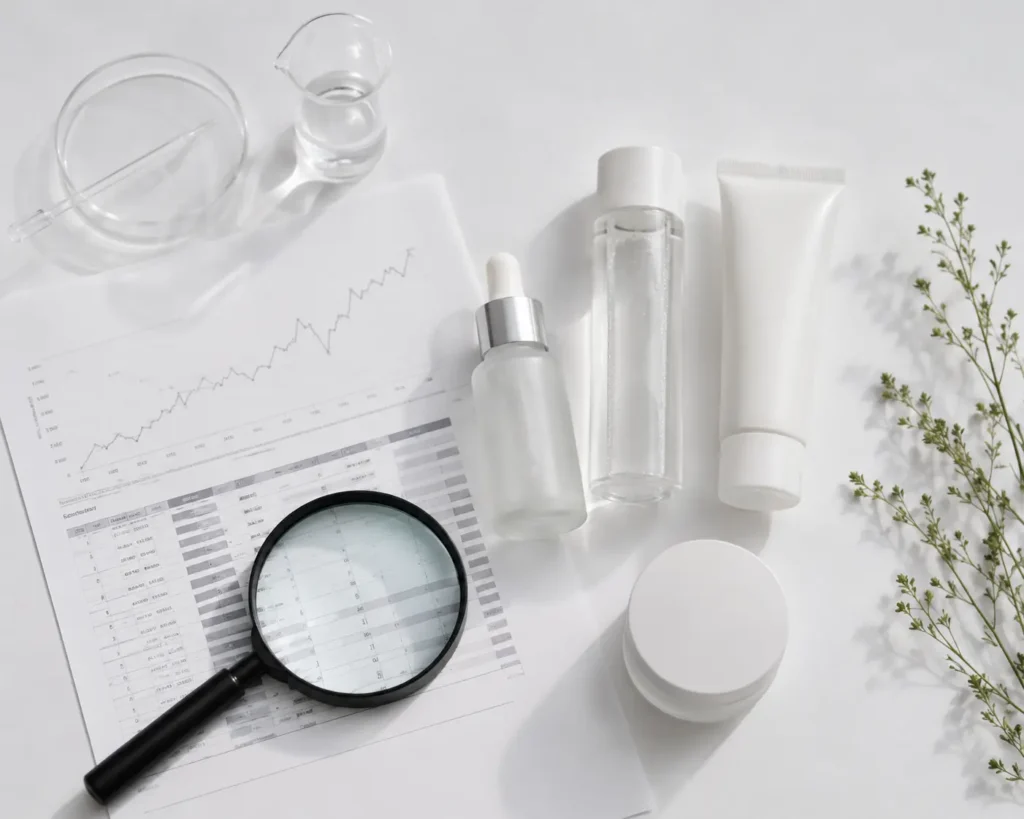
Skincare Products Win on Formulation Evidence, Not Branding
Most skincare products fail in year two because founders optimize the label before they optimize the molecule.
The ROI Math Nobody Runs Before Launch
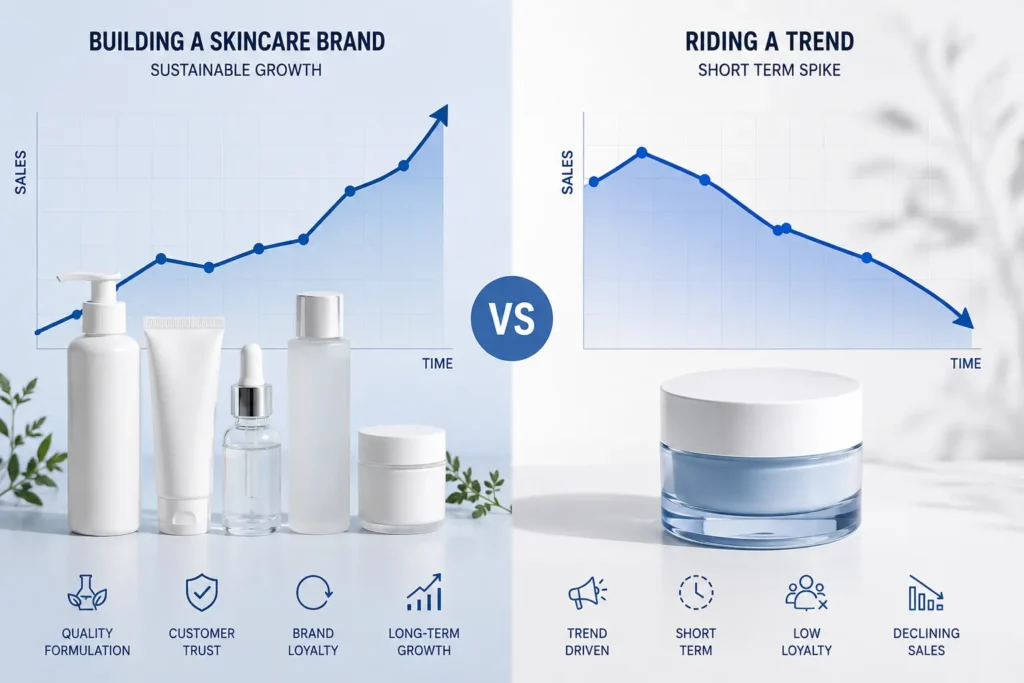
Technical founders already know how to model unit economics for software. Apply the same discipline to skincare products, and the picture changes fast. A hero SKU built on a proprietary blend with weak clinical support might close a strong first cohort through paid social, but repeat purchase rate collapses once the novelty fades and reviews catch up. Compare that to a founder who spends an extra six weeks on formulation testing before launch. The upfront cost looks worse on a burn-rate spreadsheet. The eighteen-month retention curve tells the opposite story, because customers reorder skincare products that visibly work, not products that photograph well.
Drunk Elephant built its early growth on ingredient transparency and percentage-labeled actives, not lifestyle imagery. The brand published exact concentrations of retinol, vitamin C, and AHAs on packaging, turning the product itself into the marketing asset. Founders can replicate that mechanism without replicating the brand: treat the ingredient deck as a growth asset, not a legal formality. Run the numbers on customer acquisition cost against 90-day repurchase rate for evidence-backed skincare products versus trend-driven ones in your category, and evidence-backed formulations win on lifetime value almost every time, because the product does the retention work that ad spend can’t.
Speed Comes From Picking the Right Actives, Not Skipping Testing

Series A founders are trained to move fast and iterate. Applied naively to skincare products, that instinct produces disasters: allergic reactions, returns, and a founder issuing an apology post instead of a funding announcement. Applied correctly, speed comes from narrowing the formulation space early using published clinical literature instead of running blind trial-and-error batches.
Niacinamide, retinoids, vitamin C, and peptides carry decades of peer-reviewed data on stability, dosage thresholds, and skin penetration. A formulation chemist working from that literature can cut development cycles by months compared to one guessing at novel botanical extracts with no safety or efficacy data behind them. The Ordinary compressed a multi-year formulation cycle into a repeatable playbook precisely because it built on ingredients with existing clinical backing rather than chasing proprietary novelty. Founders who want speed should treat the existing dermatology literature the way a software team treats an open-source library: don’t rebuild what’s already proven, ship on top of it.
Real Examples Beat Testimonials in Every Channel That Matters
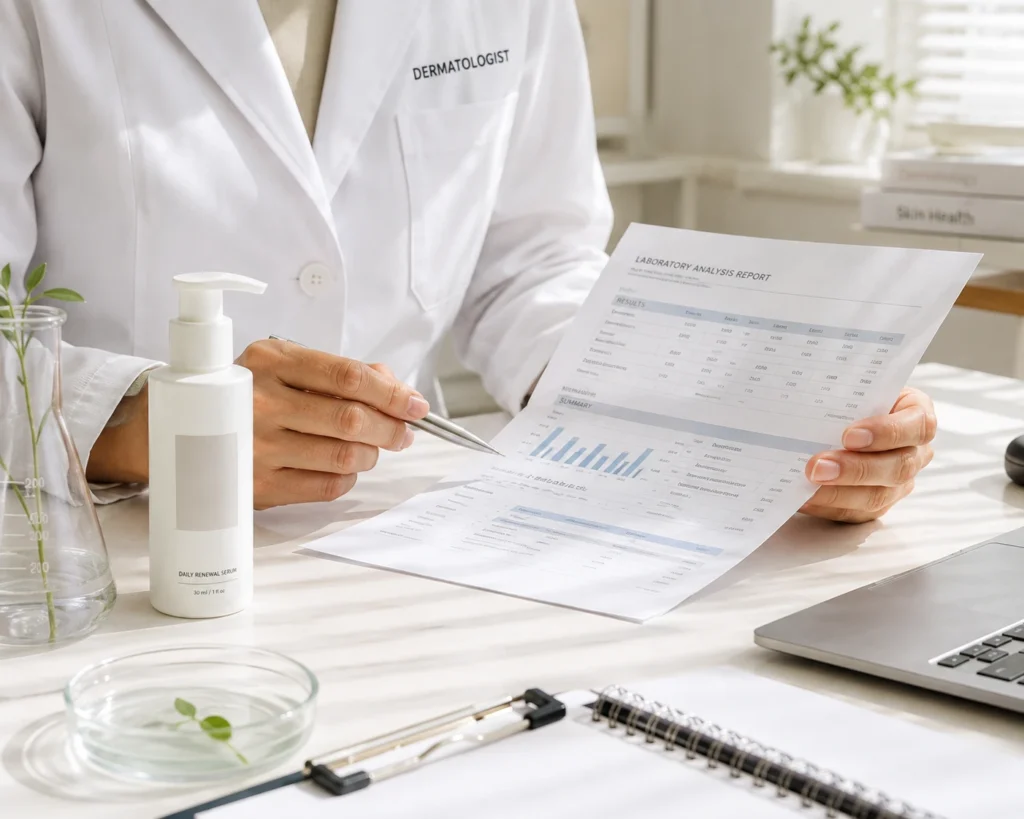
Testimonials convert cold traffic. They stop working the moment a customer has tried three competing skincare products that all made similar claims. What survives scrutiny is data a customer can independently verify: before-and-after measurements taken under consistent lighting and timing, third-party lab results, or a published concentration of the active ingredient.
CeraVe scaled almost entirely on dermatologist endorsement and ingredient specificity rather than influencer testimonials, and it now sits among the highest-repurchased skincare products in mass retail. That outcome didn’t come from a bigger media budget. It came from a formulation dermatologists could vouch for without hedging. Founders building a content or growth engine around skincare products should budget for a small independent efficacy study before the big campaign, not after it. A single third-party study with fifty participants and a clear measurement protocol outperforms a thousand five-star reviews on trust, because reviews are self-selected and a controlled study isn’t.
EEAT Isn’t a Compliance Checkbox, It’s a Distribution Advantage

Google’s Experience, Expertise, Authoritativeness, and Trust framework was built for exactly this category because skincare products sit inside the Your Money or Your Life classification, where search algorithms actively penalize thin, unverified claims. Founders often treat EEAT as a legal or SEO afterthought handled by a contractor after launch. That sequencing costs organic distribution for the first twelve months, when organic traffic is cheapest and most durable.
Build EEAT signals into the product development process itself. Have a licensed dermatologist or cosmetic chemist review formulation claims before they go on any product page, and credit that reviewer by name and credential on the page. Publish the actual concentration of active ingredients rather than vague marketing language like “powered by botanicals.” Link every efficacy claim to a specific study rather than a general statement about the ingredient category. Paula’s Choice built a content moat this way, publishing ingredient dictionaries backed by citations that both consumers and Google’s algorithm treat as authoritative.
A Series A founder with engineering discipline can build the same asset faster than a traditional beauty brand, because the underlying skill, structured evidence and rigorous sourcing, is the same skill used to write technical documentation.
Founders who skip this step don’t just risk a Google penalty. They lose the compounding SEO asset that makes paid acquisition unnecessary within two years, forcing permanent dependence on rising ad costs for every unit sold.
Skincare products that survive past Series A are the ones built on evidence a customer can verify, not a story a customer is asked to trust. Formulate for proof first, and the growth channel takes care of itself.
Resources
1.FDA – Cosmeticshttps://www.fda.gov/cosmetics
2.PubMed – Biomedical & Skincare Researchhttps://pubmed.ncbi.nlm.nih.gov/